Once upon a time, there was a writer who sat about, bemoaning her writerly problems. “Oh, dear,” she said. “I’m stuck in a writer’s block!” Or, “Heavens to Betsy! How will I ever get any writing done with home, family and work responsibilities?” Until finally, she foolishly plopped down in the middle of the floor, putting off the whole writing thing altogether.

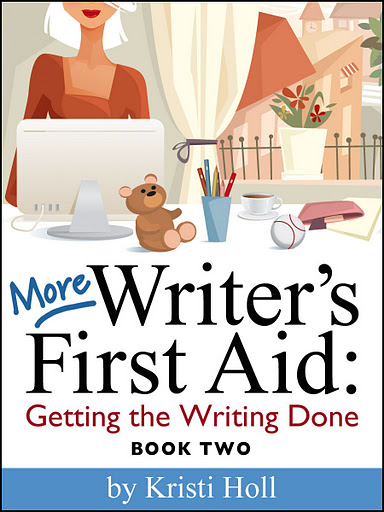
Fortunately, a wise friend (coincidentally, her name was Cathy) knew of Kristi Holl and her book, More Writer’s First Aid, a book jam-packed with answers to just about any writerly thing that ails you. She asked Kristi a few questions, to get her friend back on track. Let’s listen in, shall we?
So, Kristi, what’s the writing problem you most often hear about from struggling writers? And what’s one way to handle it?
The overall most common problem I hear about is how to juggle everything and still have time and/or energy for writing. Many new writers are starting at the same life stage that I began writing—with a houseful of small children. Your energy is low, your time to yourself is almost non-existent, yet you have this drive and burning desire to write stories and articles and books. (You wouldn’t mind some second income either.) Or your time/energy crunch might be for another reason: poor personal health, being a caregiver for an elderly relative, working a day job, marital problems or problems with teens that sap your energy, you name it. Lives today are so busy. This is why I started the “Rx for Writers” on the Institute of Children’s Literature website back in 1998, and why I wrote Writer’s First Aid and More Writer’s First Aid. My students—many of them very talented—weren’t quitting because they couldn’t figure out dialogue or description. They were quitting because life issues were sapping their energy and stealing their time.
One way to handle this? No matter what the issue, learn to write in tiny bits and pieces of time if you need to. Be ready, even if you only have ten minutes, to sit down and write. Have your story outlined so you know which piece to work on next. “Pre-write” or “pre-think” about the next part while doing those non-thinking activities (pushing kids on the swings, sweeping, pulling weeds, etc.) Then when you have ten or fifteen minutes free, dash to the keyboard (or keep a notebook and pen with you) and write like crazy. (I wrote my first five middle-grade novels this way.)
I know you’ve been writing for more than 30 years and published nearly 40 books! What do you know about writing and getting published that we don’t know?
Two things that experienced writers know that beginners usually don’t can make all the difference in whether you make it as a writer or not. (1) I know that persistence is more important than talent. That stick-to-it-iveness factor wins out every time. Talent is much more common, but talent won’t take you nearly as far as you might think. I’ve watched over the years which of my students went on to have books published by some of the biggest publishers. They were not the students I first predicted. Seldom were they the most talented, and occasionally I couldn’t see much hope in their work at all. But each of the students who went on to publish well—and repeatedly—simply didn’t give up. They studied and wrote and grew and wrote and read books and wrote and got critiqued and wrote and submitted and got rejected and kept writing. (2) The second bit of knowledge is this: every writer gets rejected, and the rejections don’t stop unless you stop submitting. Rejections are simply a part of the writing life. They’re a job hazard, like firemen who occasionally get burned. It just goes with the territory. If you don’t know this, you can erroneously believe your career is over when you get a string of rejections after several acceptances. Not true. Rejections happen to even the most famous writers—and they happen routinely and throughout your career. It won’t hurt that much after a while either—which is more good news!
What’s the writing obstacle that you most often deal with? And how do you deal with it?
It’s the same writing obstacle I’ve always had, I think. I have difficulty balancing everything and not feeling guilty about devoting so much time to writing and marketing and blogging. When my kids were little and I was writing, I was afraid I might neglect them. (They’re grown now, and they’ve turned out beautifully.) At this stage of my life, I’m afraid I’ll neglect my grandkids (they all live within ten minutes of me) and not give my grown daughters enough breaks. All my life it’s been a 90% needless worry. I’ve always been very involved with my kids and grandkids and some ministries at church. But sometimes I wish I could clone myself. One self would be the full-time writer who did nothing but write and read writing magazines and do writing exercises, etc. The other self would be on-call and involved full-time with family. I used to laugh that I prioritized according to guilt—but I was only half joking! One way I deal with it is to put things on the calendar and look ahead month by month. If it’s been longer than I like since I’ve seen the grandkids, I set up individual lunch dates with them or longer overnight stays. I don’t trust my memory.
Since this book is More Writer’s First Aid, there must have been a Writer’s First Aid. What’s the “more” in this book?
Some of the “more” is simply “more help” along the lines of the first book. Another “more” is more actual articles/short chapters (48 instead of 40). And the last “more” is because I’ve included a section this time on “Family Matters.” I think for most writers that juggling family and writing is a big issue, and it’s big whether you’re a single mom writer or a working dad writer or a grandma whose adult child and grandkids just moved back home and now “live” in her former writing office. Combining families and writing (successfully) is an ongoing challenge.
And finally, if you were a tree, what kind would you be? Hahaha! Just a little April Fool’s humor there. (Um, unless you really would like to be a tree…) But if you weren’t a tree, and you weren’t a writer, what do you think you’d be doing now?
If I were a tree, it would be a white pine Christmas tree—the kind with the long needles. When the kids were growing up, we grew our own white pines on the farm (in Iowa) and cut our own Christmas trees. Nothing ever smelled so good!
If I weren’t a tree or a writer, what would I be? I have no idea! It would have to be book related, I think…like work in a bookstore or library. But I might get fired the first week—once they found me curled up in a corner with a stack of books. I wouldn’t handle that kind of temptation well!
Thank goodness, Kristi is a wonderful writer. You can read her blog, Writer’s First Aid, for a daily dose of writing hope, and you can purchase her book for your Kindle, or get the paperback or the e-book. And because she’s extra swell (or maybe because I sorta begged), she’s giving away an e-book of More Writer’s First Aid for one of my lucky commenters. Make sure that I know where to get in touch with you, or Kristi won’t be able to send you the e-book!
So, friends, don’t make me write another story called “The Foolish Writer Who Plopped on the Floor and Turned Into a Big Giant Blob.” Because now there are no excuses—you know where to find all the answers to your writing problems—and coincidentally, I bet you’ll find your happy-ever-after writing ending, too!




 Cathy C. Hall Writes