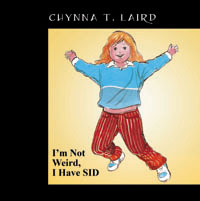
 When I read Chynna T. Laird’s picture book about her daughter’s sensory processing disorder, I didn’t know whether to sob or smile. Diagnosed with a disorder that left her daughter crying with pain at the slightest touch is hard to imagine! But I ended up smiling, after all. Because Chynna has written a sensitive and uplifting book that’s sure to help many kids and parents on this same journey.
She’s here today to share a few keepers about writing a picture book, starting with the process of getting into her daughter’s “skin.” I’ll let Chynna pick up the story…
When I first wrote the manuscript for I’m Not Weird, I Have SPD, I questioned whether I should put the subject matter into book form. Would kids “get” the idea behind the book? Would parents/caregivers? Was I telling the story the “right” way so as not to upset those whose children have the same condition? I decided the best way to tell a story about a girl with special needs was to (a) get into that girl’s world so I could describe it; and (b) tell it from her perspective.
Now, as parent, I already understood Jaimie very well but, admittedly, I didn’t understand how things felt to her because my sensory sensitivities aren’t as severe as hers. So I did “field” research: I wore itchy, wool sweaters on my bare skin; I put my shoes on the wrong feet and tried walking around; I wore heavy clothes when it was hot; I tried working with a intense bright light shining in my face; I even spent a day doing everything with my left hand instead of my right. Then I really listened to how my kids and their friends spoke to each other.
Because when you write for kids, you not only have to speak to them appropriately so that it’s entertaining but you also must talk about certain subjects in a manner they’ll understand. Of course, you don’t want to be condescending either—kids are a lot smarter than we often give them credit for.
That’s great advice for any children’s writer! But I especially love Chynna’s determination to get a true feel for her daughter’s world. Next, Chynna gives us a peek into POD publishing.
My decision to go through a POD publisher (Outskirts Press) was because I wanted to be a part of every aspect of the publishing process. I also wanted to retain my rights to my story in case I chose to publish it traditionally later on. Plus, I never intended it to be for more than my family and close friends—to help them understand Jaimie a bit better. But then I gave it to other parents of children with SPD, our local library, local SPD therapy centers and even in Jaimie’s school!
All in all, I’m very happy with the results. For those who don’t want to handle all of the marketing and funding of their books themselves, you should definitely pursue the traditional publishing route. But here’s a few tips you should be aware of, some of which made me choose the self-publishing/POD route:
(1) A lot of agencies/publishers aren’t able to or even want to take on a book that has a tight niche—they aren’t as easy to sell. If you have a book with a specific audience, as I did, see if there’s another angle you can use to sell your idea. For example, my book is great for teachers, counselors, parents and other caregivers. And my new edition with the activities will help make it more interactive.
(2) The market is saturated for special needs children’s picture books, or so I was told by a few places, so make sure you tell your story from a different angle. Give it that wonderful element that hasn’t been seen in other books.
(3) Even those places who do take on special needs children’s picture books will only take on a few each year (Hence, the saturation problem.) Before querying an agent or publisher, email them and briefly describe your project, the audience you intend to target and ask what their editorial needs are.
(4) There are a few agencies/publishers who will take on these sorts of projects as long as the author has a solid platform. If the author is well-known or established in the community the book is written in/for, the agent or editor will have an easier time selling your book. So that niche problem in #1 wouldn’t be as much as a problem if the author has their audience all set up and ready to buy the book. Those without the platform, unfortunately, wouldn’t have the same edge.
All of that said, here’s my last piece of advice: Tell your story. Really! The more books out there that reach out, help to educate and to bring awareness to these disorders the better. Children are amazing people—they are the future. And if we give them this information in a beautiful book form, they’ll treasure it all the more.
Good luck and happy writing.
See what I mean about uplifting? Every page, every sentence in I’m Not Weird, I Have SPD is underlined with love. You can see for yourself. Just leave a comment, and if I pick your name on Monday, July 20th, you’ll receive this picture book. Oh, and if you have any questions about the writing process or POD publishing, ask away. Chynna will be dropping in today and she’s happy to help! Which is so like Chynna, isn’t it?

