Gosh, I hope I can squeeze everything into this fun two-fer-one today! So off we go…
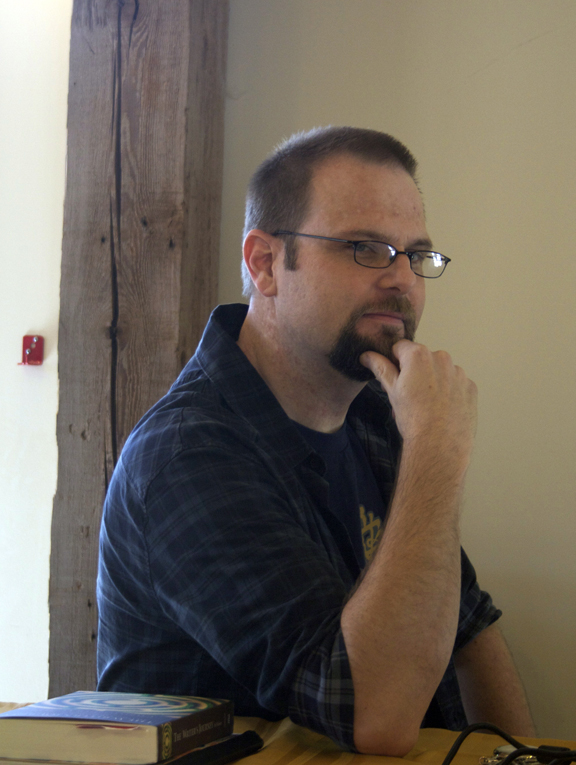 On the ride from the airport to the Highlights Workshop, awesome author Alan Gratz went on and on about Dropbox, a free storage service. In fact, he sang its praises so loudly that, even though I wasn’t absolutely sure I understood everything that Dropbox could do for me, I wanted it. I wanted it bad. (And now I have it.)
But Alan also talked about plotting, the three act structure, crossing thresholds, tent poles and how important it is for your protagonist to actually do stuff (rather than have stuff happen to him/her/it). The thing is, you’re probably like me. You know about plotting. But understanding plotting is another thing entirely, right? So I’m keeping all the nifty Alan notes right next to me during this revision. I write and check a note. Then I write and check another note. It’s amazingly helpful.
I wish you had Alan’s notes. But I can tell you the book from which he gathered his notes (and highly recommended we read as well): The Writer’s Journey by Christopher Vogler. It’s not quite the same as having Alan explain it all. But I think it must be an awesome book. I mean, have you seen all the books Alan’s had published? (And the fact that many of them are related to baseball in no way has influenced my glowing recommendation of these books. Um, all right, all right. Maybe just a teeny bit.)
And awesome author Jeanette Ingold shared her words of wisdom about how to tighten a story. (Actually, they were pictures. I love pictures! They appeal to my visual-oh-now-I’ll-remember-this side.) My favorite one was “Just the facts, m’am.”
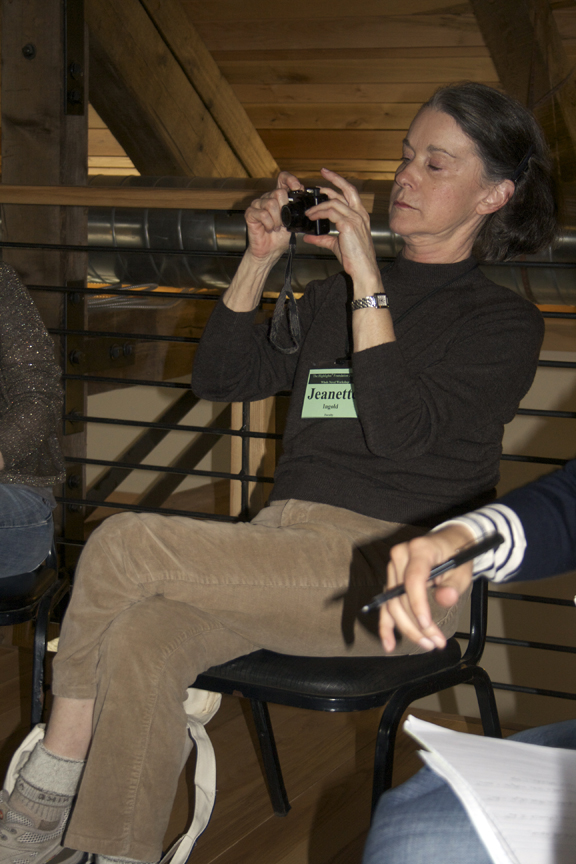 You remember Joe Friday, right? Yeah, it was Dragnet, and why yes, it was a while back. (And no, that’s not Jack Webb. That’s Jeanette Ingold).
The point Jeanette was making here had to do with dialogue, so let’s move on, shall we? Which, come to think of it, was exactly Jeanette’s point. Good dialogue is the illusion of speech. So leave out the boring stuff, the hemming and hawing (unless it’s there for a purpose). And make sure your dialogue moves the story forward. You don’t want to bury great lines in pages of dialogue.
And if you want to see how expertly Jeannette employs dialogue, read one of her many books. I just finished Hitch (It’s about the CCC) and marveled at how well she captured the speech of those young men in the late 1930’s. But I paid careful attention to the craft of her dialogue, too. And it was mighty fine stuff.
Now, tell the truth. You got lots more than a two-fer today, didn’t you? It doesn’t get any fun-ner than that.
P.S. BIG thanks to Nanci Turner Steveson for the Highlights Whole Novel Workshop pics appearing in this Fun Friday post!

 Cathy C. Hall Writes