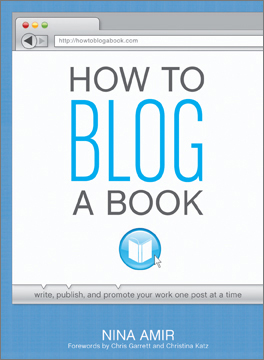
 I am thrilled to have Nina Amir, author of How to Blog a Book, here as part of her WOW! book tour! And Nina’s stuff is so good, I think it best if I step aside and let her run the show. So here’s the scoop, straight from the author’s mouth. Er, pen.
If you balk at starting a blog because you think it will take you away from writing your book consider this: Your blog could change your status from “aspiring author” to “published author.”
Want some proof? Just consider some of the bloggers who didn’t even set out to become authors but who are now published, like Julie Powell (Julie & Julia), Christian Landers (Stuff White People Like), Jill Smokler (Confessions of a Scary Mommy), Jenny Lawson (Let’s Pretend This Never Happened), and Neil Pasricha (The Book of Awesome). They wrote some pretty amazing content on their blogs, garnered a ton of fans—potential book buyers and readers—and were found by agents or publishers. They then turned their existing blog content into a book or, in some cases, wrote a book based on the topic of their blog.
How can you repeat the success of these bloggers and use your blog as the path to publication? Let’s look at what these authors had in common that helped them land their book deals:
A Blog: This served as the hub of their promotion plan; even they weren’t conscious of this fact. From their blog they built out to social networks and found followers and fans. Their blogs served as their website, but it was dynamic, rather than static—filled with keywords and keyword phrases that helped them become discover-able by the search engines and by readers.
A Good Idea: These bloggers attracted so many readers because their ideas resonated with many people. The topic about which they wrote, and the angle from which they chose to cover that topic, solved a problem a lot of people had or answered a question in many people’s minds. It added benefit to people’s lives. It touched them emotionally.
A Large Fan Base: Their blog attracted a large number of readers. This equates to an author platform, which is what most publishers require. It’s also necessary to create a successful self-published book—one that sells.
Great Content: They all wrote great content. Without great content, readers won’t stick around, come back or share your blog posts.
How can you create a successful blog and end up with a book deal? And, maybe more importantly, how can you blog and find time to write your book, too? Simple. Instead of re-purposing existing blog content, blog a book.
When you blog a book, you write it from scratch on your blog. That means you break your book down into post-sized bits and publish them, one by one on the internet. In the process, you create the first draft of your book. If you write consistently and often—2-7 days a week—and use your social networks to help promote your blog, you should begin to build a fan base. If it grows large enough, you may be found by an agent or publisher.
If you don’t get discovered in the process of blogging your book, you can send a query and a book proposal to agents and publishers. Or you can self-publish your book.
Here are some simple steps to help you blog your book:
- Choose a topic.
- Evaluate the topic’s marketability and competition.
- Re-angle your topic as necessary to make it unique in both the book store and the blogosphere.
- Create a content plan.
- Break your content plan down into post-sized bits (250-500 word pieces).
- Write and publish these post-sized bits on a schedule (2-7 times per week) on your blog.
Blogging a book is actually the quickest and easiest way to write your book and promote it at the same time. Whether you end up traditionally published or self-published, by using this method, you’ll find that your blog can help you realize your dream of becoming a published author—and a successful published author at that.
 About the Author:
Nina Amir, Inspiration to Creation Coach, inspires people to combine their purpose and passion so they Achieve More Inspired Results. She motivates both writers and non-writers to create publishable and published products, careers as authors and to achieve their goals and fulfill their purpose. The author of How to Blog a Book, Write, Publish and Promote Your Work One Post at a Time (Writer’s Digest Books), Nina has also self-published 10 short books. A sought after editor, proposal consultant, book and author coach, and blog-to-book coach, Nina’s clients’ books have sold upwards of 230,000 copies and landed deals with top publishers. She is the founder of Write Nonfiction in November and writes four blogs, including Write Nonfiction NOW!, How to Blog a Book, and As the Spirit Moves Me. Sign up for a free author, book or blog-to-book coaching session with Nina or receive her 5-Day Published Author Training Series by visiting www.copywrightcommunications.com. Find out more about Nina at www.ninaamir.com.
And follow her here:
Twitter:www.twitter.com/#!/ninaamir
Facebook: www.facebook.com/InspirationToCreation and www.facebook.com/ninaamir
LinkedIn:www.linkedin.com/pub/dir/Nina/Amir
Pinterest: www.pinterest.com/ninaamir
Google+: https://plus.google.com/107098776847894040162
YouTube: http://www.youtube.com/user/NinaAmir
I know dozens of bloggers (because I visit your blog) who are sitting on a book goldmine! Nina’s generously shared a ton of info here–and her book is packed with even more great advice and tips–to get you started, mining those nuggets. How to Blog A Book could be a golden writing opportunity for you!


 Cathy C. Hall Writes