
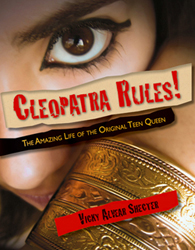
I am seriously thrilled to have Vicky Alvear Shecter visiting with us here today! And I’m even more thrilled that she’s still speaking to me. Because I asked her all sorts of questions about her latest book, Cleopatra Rules! The Amazing Life of the Original Teen Queen over at Finders & Keepers. Then I sorta badgered her to come over here and talk about writing non-fiction. And then I kinda suggested she give away something to help my writer friends.
Vicky’s a bit of a history buff. Which is like saying The Beatles were a bit of a band. But Vicky’s not your typical dry, history writer. Her brand of story telling is witty, contemporary, and very kid friendly.
So here’s my first question: Was it harder or easier for you to sell a history book with such an irreverent style?
Harder! Not everyone is comfortable with my approach although, surprisingly, the folks who seem to like it the most are classicists. They “get it” that these are real stories about real people and they appreciate the attempt at making it more lively for kids.
In order to sell this approach, I had to make sure (as I say in your other interview) that my research was unimpeachable. I used primary sources wherever possible and had four esteemed researchers/professors vet the book for accuracy.
One reviewer said the voice in the book sounded like it was written for a teen blog. I think this person may have meant this as an insult but my response was—YES! That was exactly what I was going for!
The way I figure it, it is our responsibility to get kids excited about history, to ignite their fascination with this other world that still resonates in ours. With so many tech distractions, we have to grab ‘em early. There is plenty of time, later in high school and in college, to get all formal and stuffy. I just wanted to capture their interest and imagination.
The slang and humor in your book make it such a fun read—I almost forgot I was reading history! But as you mentioned, those endnotes were stuffed with impressive research. How does a writer find “unimpeachable” references and resources? And how do you talk people into being so helpful/generous if you haven’t sold the book yet?
As with most history books, I sought out primary sources where possible. What is so interesting, though, is that the only records we have of Cleo were written by Romans, who hated her. They had a vested interest in making her look bad in order to justify an illegal war against her.
So in addition to reading the Roman sources, it was important to read the works of academics and scholars who parsed out the political motivations behind the way Cleopatra was portrayed. So I read tons of secondary sources too in order to create a fuller picture.
The first person to read the book for me was a classicist at Emory University (Dr. Katrina Dickson) who vetted it for me before I even submitted it. My editor, Larry Rosler at Boyds Mill Press, later sent the manuscript to two experts in London—classicist Dr. Dorothy King and Egyptologist Dr. Okasha El Daly.
When I integrated all of their (thankfully minor) changes, I still felt that it would be useful to have a Cleo expert bless it. So we went to Dr. Prudence Jones, a professor at Montclair University and author of several works and films on Cleopatra, to give it a final once-over. She was gracious and helpful and turned the book around for us (it was already in layout form) very quickly. In fact, all of the experts who looked at the book were extraordinarily kind and helpful!
Wow. That’s a lot of work! But I’m sure it was helpful in your next project. I know you’ve got a YA fiction book based on Cleopatra’s daughter coming out in the fall of this year. What was the impetus for switching from non-fiction to fiction? And how difficult was the switch, in writing style and tone?
The impetus was that I was absolutely floored that no one seemed to even know that Cleopatra had a daughter and that she was the only one of her four children to survive into adulthood.
I mean, we’re talking the daughter of Cleopatra and Mark Antony! Can you imagine what it must have been like to live under the shadow of such a powerful mother? It seems like it was a classic YA story ready to happen—a story of survival and a young woman’s determination to carve her own identity in history.
The writing style and tone is VERY different in the novel. So different, that sometimes I wonder if I should’ve used a pseudonym. If people expect Cleopatra’s Moon, to be light and funny like my nonfiction books, they will be very surprised. In a good way, I hope.
Sounds very mysterious and very good! Maybe you can come back and dish some more with us? Oh! Wait! I also wanted to ask you about all those photos in the book. I’ve always wondered how an author gets permission for artwork and photos to be used in a non-fiction work?
Many of the photos were public domain photos. For those that weren’t, I had to get in touch with the photographer and ask permission (in writing of course). In other cases, we had to pay for the right to use them, usually with museum artifacts.
And as if answering TONS of questions wasn’t enough, I begged Vicky to bring a photo or two from her collection and share her funny captions. She does an occasional blog post called Photo Funnies that completely cracks me up. ‘Cause who doesn’t think men in skirts are HI-larious? (Well, besides the Scots)
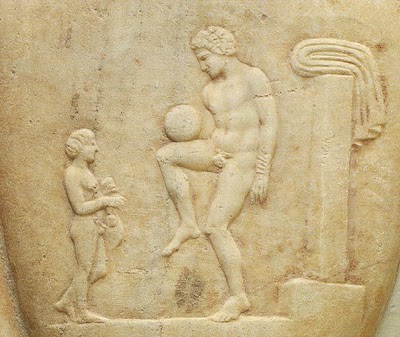
“You mean we play this game with no hands? I thought you said no pants!”
Now, zip over to her blog, History with a Twist and follow Vicky. You’ll laugh some, and you’ll go “ewwww” occasionally, but you’ll end up scathingly brilliant! And you might even end up with a free critique! Vicky’s agreed to critique the first ten pages of a fiction or non-fiction manuscript for one lucky follower. Just let me know if you signed on to follow her at her blog, Facebook or Twitter. I’ll put your name in the drawing for each connection. And on Monday, I’ll draw a name and make your Valentine’s Day even sweeter!
P.S. If you want to know more about Cleopatra, and maybe win Cleopatra Rules!, zip over to Finders & Keepers and leave a comment. It’s that easy.
Thank you SO much for sharing your writing insights today, Vicky! Um, you are still speaking to me, right?
LOL! However, I’ve had to put my fingers on ice since I had to type so much!

 Cathy C. Hall Writes